Size
Usually 65 mm or 75 mm between motor centres. One popular 65 mm model weighs about 23 g without its battery.

FPV basics
By the NVX engineering team, New Delhi · 26 October 2026 · 6 min read
A tiny whoop is a very small FPV drone, usually 65-75 mm across, with its propellers enclosed in ducts. It is light enough to fly indoors, cheap to crash and in India it falls in the lightest (nano) category of the Drone Rules. That makes it the most forgiving way to learn real FPV flying after a simulator.
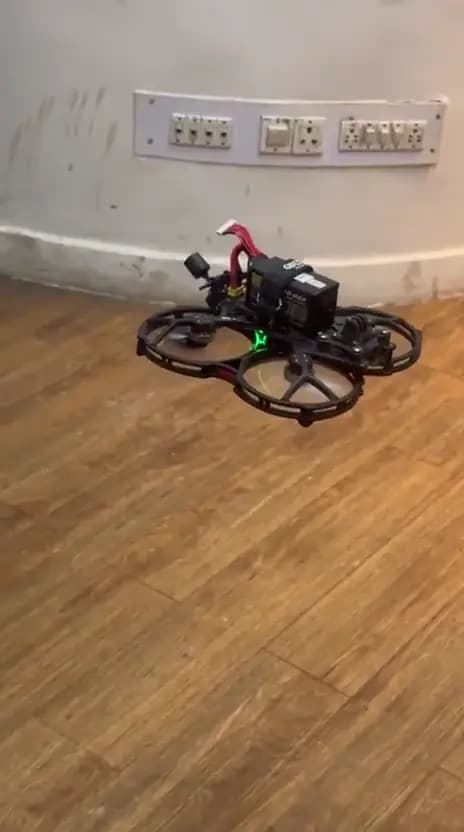
Whoops are defined by size and the ducts around the propellers.
Usually 65 mm or 75 mm between motor centres. One popular 65 mm model weighs about 23 g without its battery.
The guards are part of the frame, so bumps into walls and furniture rarely cause damage.
Single-cell (1S) whoops are calmest indoors; 2S whoops are punchier and handle a light breeze outdoors.
Expect only a few minutes per battery, so plan on several batteries per session.
You fly with goggles and a radio, in angle mode first and acro mode later, exactly like a bigger FPV drone.
The whoop is the cheapest part of the kit. Budget for the rest before you buy.
Pick one with a receiver protocol your whoop supports (ExpressLRS is common). The same radio works with an FPV simulator and with your next, bigger drone.
Analogue goggles are the usual starting point for whoops; check the video system matches the drone's camera.
Four to six 1S batteries and a charger that balances them. Never leave charging batteries unattended.
Propellers, a spare frame and canopy. These wear out quickly and are the most common replacements.
A few hours on a simulator with the same radio saves many crashes.
Small does not mean rule-free. Check the latest position on digitalsky.dgca.gov.in before you fly.
Drones up to 250 g are nano drones under the Drone Rules, 2021. A whoop with its battery is far below that limit.
A remote pilot certificate is not needed to fly a nano drone.
Outdoors, follow the green, yellow and red zone map and keep the drone in sight. Do not fly over people or neighbours' homes.
Since February 2022 India has prohibited importing complete drones, with limited exceptions; drone components can be imported without approval. Buy from a seller who can show how the drone or its parts entered India.
Typical whoop problems are worn or bent propellers, a motor clogged with hair or carpet fibre, a cracked frame, broken camera wires after a hard hit, and puffed batteries from over-discharging. Clean the motors after indoor flights, land when the battery warning starts, and store 1S batteries at storage charge. Replacing a frame or a motor on a whoop is a small job, which is exactly why they are good for learning.
FAQ
A very small FPV drone, usually 65-75 mm, with ducted propellers. You fly it with goggles and a radio, often indoors.
Yes. It is light, crash-tolerant and cheap to repair, and it teaches the same stick skills as bigger FPV drones. Practise on a simulator first.
A whoop is a nano drone (up to 250 g). No remote pilot certificate is needed, and nano drones are generally exempt from registration for recreational flying. Confirm the latest rules on Digital Sky.
A 1S whoop is best indoors or in still air. 2S whoops cope better outside, but any whoop is easily blown away by wind.
Usually just a few minutes, which is why pilots carry several batteries.
NVX supplies FPV parts and accessories from its Connaught Place store, with an itemised quote including GST. NVX does not sell ready-built FPV drones.
Talk to NVX
Call +91 95609 21619, message us on WhatsApp, or visit us in Connaught Place, New Delhi.
Related